The CDT goes right down Main Street through Lordsburg. Half way through town the Barber waved at us and asked if we wanted water. Even though there is not a single sign for the CDT in town there were still a few folks that knew about the trail.The route out of town takes the highway north for about two miles. Now personally, I think paved-road walking has very little to do with thru-hiking and I generally avoid it, but since it was just a couple of miles we put one foot in front of the other and proceeded onward. While the radiant heat of the highway cooked me from below the sun cooked my brain from above. Occasionally a semi truck would pass by and shake my body back to reality.After a couple of miles there was finally a small CDT sign encouraging us to crawl under a barbwire fence to go cross-country. I thought this a bit odd—that right off the highway, in an area where very few people know about the trail, there wasn’t a gate to access the trail as crawling under the fence right along the main highway sort of shouts out trespasser instead of CDT hiker.We spent the night on the dry cracked desert floor and were greeted with a few sprinkles of rain in the morning. From here the route took us up into the Burro Mountains leaving the desert and the heat behind us. It was refreshing to be in the trees again and the miles passed by quickly.About half way through the Burro Mountains the CDT began to follow an actual trail for the very first time. We spent the night in a cattle corral. It was surely the worst possible place to sleep, but I think we were so tired when we arrived at the cattle tank (water) that we just didn’t have the energy to think about it.Before leaving the Burro Mountains the trail goes up and over Big Burro Mountain to an elevation of 8000 feet. We took the Deadman’s Canyon trail to the dirt road that leads to to highway and within five minutes we had a ride into to Silver City.
Category: Continental Divide Trail
-
CDT 3: Silver City to Gila Hot Springs
After a great zero (zero hiking miles for a day) with some wonderful trail angels in Silver City we headed back to the trail off of Bear Mountain road. Near Devil’s Garden, a rocky area much like Chiricahua National Monument, we met a guy who had been living the woods there for 15 years—an interesting character that told us all about the trail sections he had built, the condition of upcoming trail, and where we could find water.We made it to the Gila River where the miles went by so slowly. In two days we crossed the Gila 59 times (and our upcoming section has another 85 crossings). We arrived at Doc Campbell’s outpost after they had closed, but much to the relief of our hungry tummies a lovely lady opened the store so we could get our resupply boxes. I felt like a kid at Christmas with a box full of treasures. We stayed at the nearby hot springs campground and soaked until our muscles came back to life.
-
CDT 1 – The Southern Terminus of the CDT to Lordsburg, NM
After a long day of driving, caching water for the first 92 miles of the trail, and one flat tire on the access road to the southern terminus we finally made it to Cooke’s Monument for a 6:30 PM start. We made it a few miles before the sun set. Crickets, cows, and coyotes sang us to sleep. It was a very romantic beginning to this long trek north.We woke just before dawn. The coyotes were still howling in the distance. We hiked some on a dirt road and then the signs led us cross country. After a 22 mile day we both agreed that trekking cross-country with no trail is exhausting.When we arrived at our second water cache, five sets of glowing green eyes were staring at us. It took a second, but we quickly realized the glowing eyes belonged to cows. We made it to our cached water and set up camp to the rumble of border patrol on quads riding along the side of highway 81. We settled in for the night and watched two spiders wrestle; by headlamp, they looked like cyclopses with one giant glowing green eye.After a couple of hot days we decided to take the alternate route to our last water cache before Lordsburg. The alternate route stayed closer to the divide and went up into the hills where it was cooler. It also had more road walking, which we thought would be a nice change from cross country. As the day dwindled we decided to stay on the road until it met up with the road our water was near. It was a lot further though and turned out to be a bit too much road walking. We got to the last water cache well after dark. As I exploded my pack and settled in for the evening my body began to tell me just how much it thought the day dragged on past its threshold. Nausea set in followed by a few shivers and random sharp twinges of pain. The night passed with a blur, and I awoke feeling much refreshed and ready to conquer the last ~8 miles to Lordsburg.
-

Walking Lighter: Homemade gear and other things I carry on a long walk…
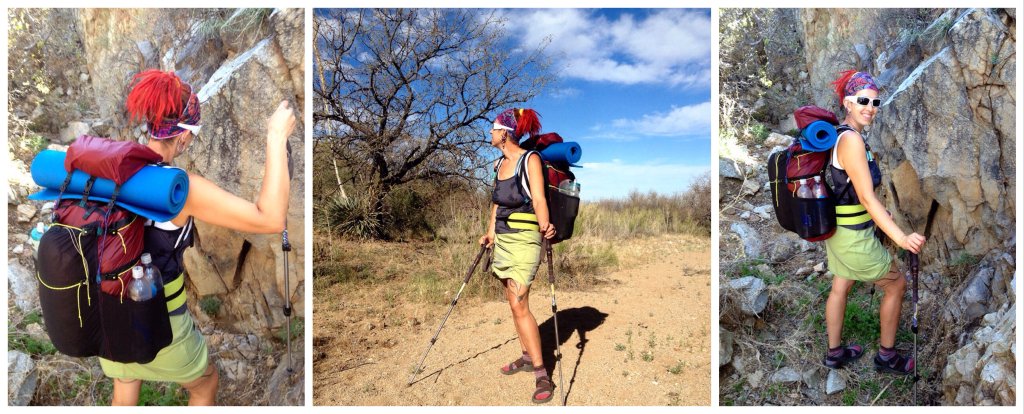
My Inspiration to Walk Lighter
I have been sewing since I was 11 years old and, as an artist, making my own gear was a natural evolution of my hiking experience. My first overnight backpacking experience was about 9 years ago. I used a borrowed Kelty pack that weighed nearly 6 pounds and my sleeping bag weighed almost 5 pounds. By the time I got all my “stuff” into the pack it always ended up weighing ~50-60 lbs. Guys would always brag “oh, that’s nothing, I used to carry an 80 pound pack back in the day”. Fine enough, but after a few miles of hiking I was so tired I would have to prop the pack up on rock or a log to get it back on after a break because I could no longer lift it off the ground and back onto to my body.After several years of torturing my self with a heavy pack the final touch to inspire me to go lighter happened on a climb of Mt Rainier with that same heavy Kelty pack and all my climbing gear. On the snow slog up to Camp Muir I slipped in the snow and landed on my back. My pack was so heavy I couldn’t get back up without taking it off . The problem was that there was no rock or log around to prop my pack up onto and I couldn’t lift it off the ground and back onto my body. Immediately following that trip I bought a lighter pack and axed a bunch of stuff and clothes from my list of must haves–this included my rain jacket, toiletries, first-aid kit, pocket knife, extra socks, etc. From that trip on I have slowly acquired lighter gear and stopped carrying much of the stuff I used to think I needed.Every single backpacking experience since my first one has left me with visions for how to hike lighter. A lighter sleeping bag and pack were an obvious place to start. The tent wasn’t such an issue because I only ever carried half of it while my hiking partner carried the other half. I have made all my rain gear, which includes pullover jacket with hood, chaps, skirt, mittens, and booties. I have made my hiking skirt, sun-shirt, sleeping bag, sleeping bag liner, puffy jacket, puffy pants, puffy mittens, and modified a lot of my bought gear. I swore I’d never make a backpack, but this year in preparation for my Continental Divide Thru-hike I ended up making three packs.

Homemade Backpack
My backpack design was an evolution of an idea that started as a simple daypack design. I thought “why not just buy some ready made straps and attach them to a ready made light-weight stuff sack?” Then my dreams got bigger and I thought “why not do that for a bigger pack and add a hip-belt too?”One thing led to another and I ended up making three packs for this hike. The first one was great. I basically made a basket like structure out of very lightweight webbing with a hip-belt and shoulder straps attached to it. The basket webbing structure is designed to hold a large stuff sack. That pack weighs ~9oz. But as I started adding lightweight fabric shear panels and pockets to it I decided to start completely over in hopes to simplify the design for easier replication.My second pack design was indeed easier to construct, but it still turned out to be very complicated. By the time I started making my husband’s pack, the third generation of my design, I started to think of how I would make it different the next time around. That is until I weighed my pack, the second pack I made, which even with all the pockets and top lid comes in under a pound at ~14 oz.The primary structure of the pack is grosgrain ribbon, which is like very lightweight webbing. I enclosed the pack with sil-nylon, which is a silicone coated ripstop nylon. It has stretchy pockets on the back and sides. And I designed load lifters that use the top lid as part the tensioning system.

Hiking in Sandals, Socks, and Other Items Worn
I hike in sandals–Chacos Uniweep Z1 sandals are the best. In running shoes and hiking boots I constantly twist my ankles. I think I am supposed to knock on wood here, but I have hiked thousands of miles in sandals and never twisted my ankle. My theory is that shoes constrict the natural articulation and movement of my foot, which doesn’t allow me to compensate for a wobbly step on uneven terrain–thereby the shoe or hiking boot actually causes me to twist my ankle by restricting my natural movement.About 20 years ago I broke the navicular in my right foot. The navicular is the keystone of your foot arch. For most of those 20 years I would often have a bit of ache in my foot or a shriek of bad feeling when I would turn my foot a certain way, but in the last couple of years since I’ve been wearing Chacos I have nearly forgotten that I had ever broken my foot at all.My feet and ankles are happier in sandals—they are able to be much more agile and natural in sandals. And happy feet equal happy hiking.Chacos last forever, have an ergonomic foot bed, and they don’t trap my toes. I also like that they don’t have an internal hard plastic arch support. I’ve hiked in other sandals that do and as soon as the soft cushion foot bed starts to compress and wear out the hard plastic arch support starts to feel like I am walking with a huge stick stuck in my sandal. This does not happen with Chacos. Chacos also have knobby Vibram outsoles with excellent traction and are thick enough that rocky terrain underfoot is not a problem.I wear Darn Tough wool socks and am proud to be sponsored by Darn Tough for this thru-hike. They really are the best socks I have ever worn. They literally can hold up to a thru-hike, which is not an easy task. The Darn Tough socks I bought for the Pacific Crest Trail, though a bit threadbare after thousands of miles, are still going strong. If you want a comfortable pair of socks that will keep going long after you have exhausted your motivation to keep walking then Darn Tough is the sock you want.When the weather is warm I like to hike in spandex shorts, a skirt, and tank top. I do not use sunblock so when the sun is intense and high overhead I use a sun shirt, sun gloves, and a visor with an added neck drape to protect my skin. I like using a visor instead of a hat for two reasons; one, I sweat a lot and the visor provides more ventilation than a hat; and two, I like to wear my hair up because it lets more air circulate around my neck and face, which keeps me cooler.Hiking in a skirt is something I came to love on my 2012 thru-hike of the Pacific Crest Trail. I can wear spandex shorts underneath it and along with a sports bra I am ready for swimming at the first sight of fresh water. When the weather is cooler it also makes it easy and discreet to slip tights on and off no matter who is around. I have also found that in colder weather my butt stays much warmer if I am hiking in a skirt with light tights underneath than if I wear thermals under hiking pants. I designed the skirt I will be wearing on this trek. It has two draw cords on the front so that I can raise the hem in warmer weather and lower it in cooler weather.Before hiking the Pacific Crest Trail I did not use trekking poles, now I even use them on day hikes. I find I walk up hills faster and they really take the weight off my knees on the down hills.

Extra Clothes Carried for Cold Weather
I find I stay warmer simply by adding a variety of light layers as opposed to a heavy bulky layer. I like to use a neck gator to keep the wind from blowing down my neck and into my jacket. The combination of a Buff and light hat covers a wide range of temperatures. Light hiking tights under my skirt are great and with the addition of light leg warmers I am very comfortable down to freezing temperatures. A light thermal shirt with a wind shirt over it is a very warm combination in cold weather. And with the addition of a light insulated jacket, light gloves, and light insulated mittens I am good for a mountain expedition. I made my insulated jacket for this hike. It weighs 10 ounces, it is long enough to cover my butt, has a hood, sleeves long enough to actually keep my wrists covered when I raise my arms, and two inside pockets.

Homemade Rain Gear
I designed and made all my rain gear. I made it with Ultra-Sil. Ultra-sil is sil-nylon except it is stronger and lighter. It is not breathable, but when it is really raining breathable does not work anyway. My rain gear makes a great vapor barrier and doubles as a lightweight bivy solution on my mountain ventures.My rain gear consists of a pullover jacket with a hood, which is sort of like a poncho except that it has full length arms, rain chaps, skirt, mittens, and booties (very useful for a sandal hiker).

Water & Treatment and Other “Stuff” I Carry
I carry a lot of water bottles. I like to have a five liter capacity in the desert. I carry two 1L Smart Water bottles, a collapsible 1L Platypus bottle, and a 2L Platypus bladder with a hose. I love my 2L Platypus Hoser bladder with the single fill/drink tube opening. It is very light weight, uncomplicated, and I find that if I take a little sips of water often that I actually drink less water and feel less thirsty than if I keep all my water in bottles. I think I always wait too long to drink from bottles because it is such a pain to reach around into my side pocket to get the bottle so when I do finally drink I end up guzzling the whole bottle of water and still feeling thirsty. I keep the Platypus bladder on the outside of my pack in my side pocket so that it is easier to fill and also so I can see how much water is in itIn cattle country I treat my water. In the desert I like to filter my water with the Sawyer Squeeze filter. It only weighs 3 ounces and it is easy to use. As weather gets colder I prefer to use a Steripen for water treatment to keep my hands from freezing. In high mountain areas I do not treat my water.Other Stuff I carry…I carry several safety pins. I use these as clothespins to attach wet socks or other wet clothes to one of the draw cords on my pack like a clothesline. I do not carry a pocket knife. The only thing it is good for is opening difficult plastic food packaging. Instead I carry nail clippers, which are lighter than most pocket knives, much more useful, and they can still open up those difficult to get into food items. As a nail biter I also like having an Emory board to keep my nails filed smooth so that I don’t bite them down to the quick.I use a child’s toothbrush with much of the handle cut off. I do not use toothpaste (not even at home). I prefer using a tooth powder, either homemade from a mixture of kitchen spices, or a ready-made formula like Dr. Christopher’s or EcoDent.I think the silliest thing I carry in my pack is a one-inch length of eyeliner. It really is a wasted weight in my pack, but I love having it on my town days. I carry a small sewing kit that consists of a sewing needle wrapped in heavy paper and thread on a light plastic bobbin. I carry a couple of water treatment pills just in case I run into some really, really, bad water that I have to drink, but looks as though it needs extra special treatment. I also carry duct tape, Tenacious Tape, Arniflora Arnica Gel, and Arnica homeopathic pills. For my periods I use Instead Soft Cups, which are a disposable menstrual cup. I have tried reusable menstrual cups like The Keeper, but I prefer the shape of the Soft Cup.I do not carry a stove, but I carry a Ziploc container for use as a bowl and a light spoon for mixing drink mixes, gelling chia seed, mixing protein powders, etc. I carry a bandana and two handy wipes for water pre-filter, wiping the sweat from my brow, washing, drying, blowing my nose, and pee. I also carry toilet paper, a pack a tissues, chapstick on a handy caribiner, and 2 heavy Ziploc-like bags for my wallet and phone.Lastly, I carry a pillow. It weights 2.4 ounce. I do not use it under my head—it goes between or under my knees, which helps to keep the pressure off my lower back while sleeping.

Navigation, Phone, and Camera
I do not usually carry paper maps, but because the CDT is so remote, wild, unfinished, and there are so many route options I have chosen to carry paper for this trek. I will also be carrying a traditional compass, which I do not carry for other hikes.I have Gaia, a GPS program, on my phone as well as image files of all the maps. I keep my phone in a Mophie battery case for added protection and it can charge my phone 2 1/2 times while on trail. I also carry my phone charger and camera battery charger for when I get to town.My camera is a Sony NEX. In addition to the battery charger I will carry a spare battery and several SD cards. I will also carry a Mophie battery pack for charging the camera battery while on trail. All this can be stored away in a dry bag during wet or dusty weather.

Sleeping
My sleeping bag is another homemade ware. It weighs 17 ounces and is all synthetic. It is a cross between a sleeping bag and a quilt in that I did not add insulation on the bottom of the bag in an area the size of my sleeping pad. My sleeping pad is blue foam and goes on the inside of my sleeping bag. The bag has a full length zipper and zips to the bag I made for my husband. I constructed it out of 5oz Climashield Apex insulation and Pertex Quantum fabric. Pertex is a great wind block and I chose it specifically for the bag because most of the time we like to cowboy camp and wind blowing through my bag keeps me from sleeping well.

Tent
Zpacs makes amazing tents. This is the Hexamid Twin made of a Cuben Fiber tarp with a bug net attached to close it in. It sets up with trekking poles and weighs ~20 ounces with all the guy-lines, ground sheet, and stakes. It withstands heavy winds like a champion and despite its large looking footprint we have managed to set it up in some of the tiniest of places. One of its best features is that it sets up with the pointy tip of the trekking pole at the ground and the handle at the roof of the tent. Other tents that use trekking poles do just the opposite and though the tip of the trekking pole is meant to stay in a grommet at the roof of the tent I have heard way more than one story of a windy night that shot the person’s trekking pole straight through the roof of their tent shredding their tent to bits. The main downside to the Zpacs Hexamid Twin is it is a little small for two tall people, but most of the time we don’t set it up anyway.

Gear that I may or may not carry for Colorado
Because I fear being cold I also made a lightweight sleeping bag liner that in addition to being a liner bag it has extra zippers on it so that I can wear it like a jacket/nightgown. I made insulated puffy pants just in case the Colorado mountain weather is colder than my standard hiking garb can deal with. For parts of Colorado I may also carry a heavier set of insulating items, which includes a warmer set of thermals (top & bottoms), neoprene booties, and a light balaclava. Additionally, colder weather means snow, and summer weather means snow-melt, and snow-melt means mosquitoes. So I will likely carry a mosquito head net in these areas.
 ___


